CUSTOM MOLD COMPONENTS / FAQYour questions.
Clear answers.
The details that help you move forward.
From your first drawing to an agreed manufacturing scope.
04 topics · 20 questions
RFQ PREPARATION
A CLEARER START
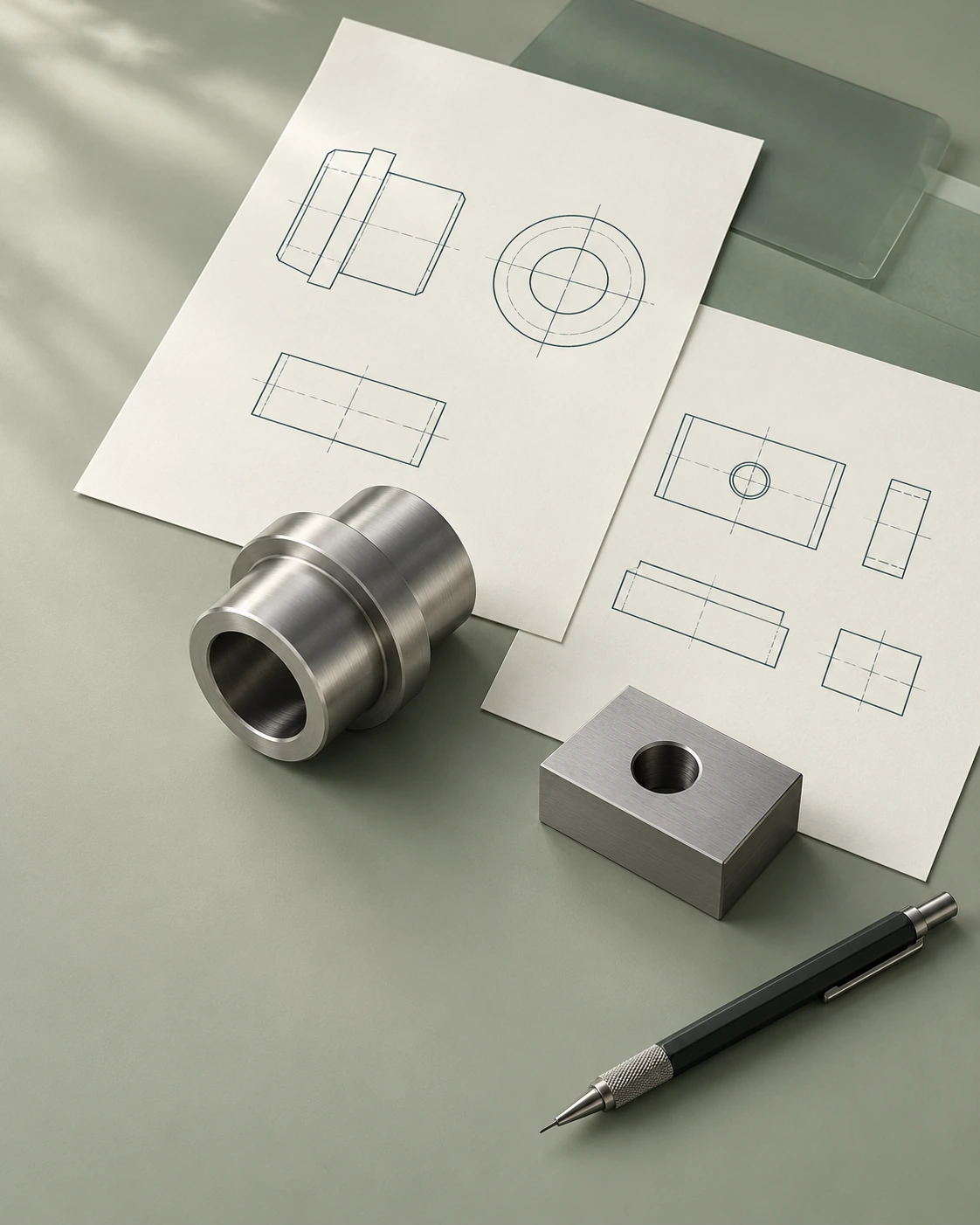
Your drawing.
Your requirements.
A defined scope.
Reviewed for the individual project.
01 / START A PROJECT
Quotation, files
& quantities
05 QUESTIONS
Start with what you have. Separate the information needed to open a conversation from the details needed to confirm a quotation.
What do I need to request a quotation?
Start with the component, quantity and target date. For a useful technical quotation, include a dimensioned 2D drawing and a matching 3D model where available, with the same revision and units. Add material, hardness or treatment, functional datums, critical tolerances, finish and required inspection documents. Mark open questions so they can be resolved before the scope is agreed.
Can I start without a complete drawing?
Yes. You can start with a short description, available sketches or photos. The current RFQ form allows an inquiry without an upload. Explain what the part does and which dimensions or mating interfaces are known. Photos help explain the request, but do not establish hidden geometry, original tolerances or acceptance criteria.
Which files can I upload?
The current RFQ form lists PDF, JPG, JPEG, PNG and ZIP, with up to five files. Package STEP/STP, IGES and DWG drawings in a ZIP file. Keep the model and drawing revisions consistent. Follow the size limit and validation shown by the form; if an upload fails, send the inquiry without the file and describe the file type and size.
Is there a minimum order quantity?
Quantity is reviewed for each drawing; there is no single minimum stated here for every component. Our order-record summary includes a completed and shipped one-piece sleeve-insert order as well as multi-piece orders. These records show prior order quantities, not an automatic acceptance rule for every new part. Provide the initial quantity and any expected repeat quantity separately.
How are price and lead time confirmed?
Both depend on the agreed drawing and project requirements. Geometry, material availability, treatment, finishing, inspection and quantity affect the route and schedule. State your required arrival date and destination, and distinguish them from the dispatch date. A requested deadline is an input for review, not a confirmed commitment; timing is agreed with the quotation and order scope.
02 / DEFINE THE COMPONENT
Materials, treatment
& surfaces
05 QUESTIONS
Specify the final condition of the component, including the surfaces that form, fit, slide or seal.
How should I specify the material?
Give the exact grade, applicable specification and required supply condition. Add material-origin or certificate requirements if they matter to the order. Similar grade names are not automatic equivalents. If alternatives are acceptable, identify the approval route and have the proposed substitution agreed before material is purchased.
Is heat treatment carried out in-house?
Heat treatment is listed as an outsourced operation in the equipment and process records. Specify the required condition, hardness range, treatment stage and documents so coordination can be included in the review. Machining and finishing allowances need to reflect the final condition. A hardness requirement on an order is not itself a measured hardness result.
How should I describe polishing or surface finish?
Identify the functional surfaces and state the finish requirement on the drawing. Separate appearance, surface texture and dimensional requirements. For a specified polish grade, name the grading system and relevant surfaces; for roughness, give the parameter and limit. A1–A3 surface grades should not be treated as dimensional tolerances or automatically converted into Ra values.
Can you coordinate coating for customer-supplied parts?
This can be reviewed as a defined service scope. Our order-record summary includes customer-supplied parts sent for outsourced DLC treatment. That is treatment coordination, not manufacture of the complete component from raw material. Provide the base material, current condition, treatment specification, areas to mask and any dimensions affected by the coating.
Are all operations performed by SENLAN?
No. The project route can include external services; heat treatment is listed as outsourced, and the records also include outsourced component and coating work. Ask for the proposed manufacturing and coordination scope to be identified during quotation. An order-level status does not establish that every individual operation was performed in-house.
03 / AGREE THE EVIDENCE
Tolerances, inspection
& documents
05 QUESTIONS
Make the functional requirement and the evidence needed to accept it part of the same discussion.
What tolerances can you achieve?
Tolerance feasibility is reviewed feature by feature against geometry, material condition, process route and measurement access. Mark the dimensions and datums that control fitting, sliding, sealing or forming. A machine specification or a recorded process figure is not a blanket part-tolerance guarantee. Final acceptance limits need to be agreed on the drawing and order.
How do we agree what needs to be inspected?
Identify critical features, datum references, drawing revision and the required final condition. State whether results are needed for individual parts, a sample or an agreed first-article scope. The measurement method must suit the feature and access. For matched parts, explain whether acceptance depends on individual dimensions, a paired fit or assembly checks.
Which reports and material documents can I request?
List the documents you need when requesting the quotation: for example, results for identified dimensions, material documentation, or heat-treatment and coating records. Confirm availability, scope and any external-provider documents before ordering. These are different records; a material certificate or treatment record does not replace a dimensional inspection report.
Does a finished or shipped status mean the part has passed inspection?
No. Production completion, shipment, measured conformity and customer acceptance are different stages. For acceptance, use the agreed inspection results tied to the component and drawing revision. If your requirement includes a fit check or mold trial, define that separately; a shipment record does not establish either outcome.
Can a replacement part be accepted from a worn sample alone?
A worn sample is a reference, not a complete definition of the intended new part. Provide the latest drawing if available, mating-part information, wear locations and the required fit. Original dimensions, material and treatment may need clarification. Any sample-based work needs an agreed scope and acceptance method before manufacturing.
04 / PLAN WHAT COMES NEXT
Replacement, privacy
& delivery
05 QUESTIONS
Agree the scope, file-sharing needs and delivery conditions before the work moves forward.
What should I include for replacement or modified components?
State whether you need a like-for-like replacement or an intentional design change. Include the drawing revision, photos or sample references, mating interfaces and the problem being addressed. Mark changed features clearly. A previous order name alone does not determine replacement intent, and manufacturing a component does not by itself establish its performance in your mold.
Can we discuss an NDA before I send drawings?
Yes. The current RFQ form includes an option to request an NDA discussion and allows the upload to be left blank. Select the appropriate option and describe the project without confidential detail. Confirm the required agreement before sharing restricted files. Selecting the option does not mean that an NDA has already been executed.
How are packaging and shipping requirements agreed?
Provide the destination, required arrival date and any special handling, identification or packaging requirements. Highlight delicate features and surfaces that must be protected from contact. Confirm the dispatch plan, transport arrangements, documentation and commercial terms with the quotation or order. No universal transit time or delivery charge is stated here.
How do I know my RFQ was submitted?
After submitting, look for the form’s confirmation message or confirmation page. If it stays on the form, check the required fields and any upload errors. A visible confirmation is not proof that an email reached an inbox. If you are unsure, use Contact Us and include the approximate submission time and project reference, without resending confidential files unnecessarily.
What if I need to change the drawing after sending the RFQ?
Send the new revision and a clear list of changes, and identify which earlier files it replaces. Ask for the quotation, route, inspection scope and timing to be reviewed against the new information. A revised upload alone does not confirm that a change has been accepted or incorporated into work already in progress.